
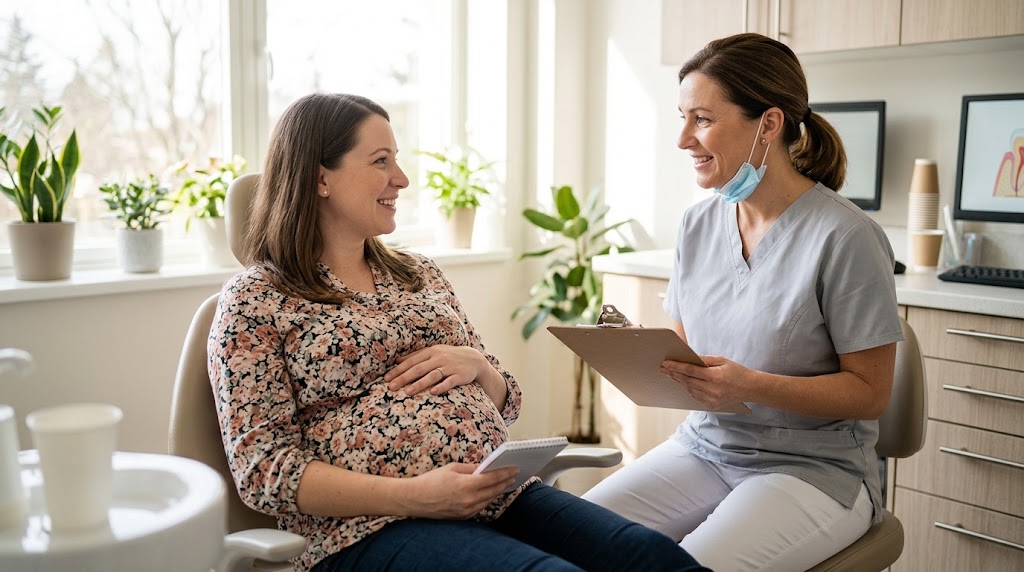
Dental Care During Pregnancy: What to Tell Your Dentist
Pregnant and due for a dental visit? Here's what to tell your Durango dentist, what routine care looks like, and what to check with your OB.

Expecting, and a reminder just popped up for your next cleaning. Should you keep it, move it, or call your OB first?
In most cases, keep it, and tell your Durango dentist you’re pregnant when you book. The American Dental Association states that preventive, diagnostic and restorative dental care is safe throughout pregnancy, and that regular and emergency dental care is safe at any stage. The American College of Obstetricians and Gynecologists (ACOG) encourages oral-health screening and dental exams as part of pregnancy care. Routine visits don’t need to wait until after the baby arrives.
Here’s what to tell your dentist, why your gums might feel different, what routine care can look like, which questions belong with your OB or midwife, and when to call sooner rather than later.
Pregnant and unsure about your next dental cleaning?
It’s completely normal to second-guess everything right now. Your days are full of new rules, prenatal appointments and advice from every direction. A dental visit can easily land in the “maybe later” pile.
Here’s the reassuring part. Dental care is safe at any stage of pregnancy, and that appropriate treatment may be needed while you’re pregnant. In other words, the ADA doesn’t tell you to put dental care on hold for nine months.
That doesn’t mean every treatment is right for every pregnancy. It means the starting point is “let’s take care of your mouth,” with your dentist and your prenatal provider each weighing in on the parts that are theirs to decide. That’s what the rest of this article is about.
And if you’ve been meaning to come in for a while and pregnancy is what finally nudged you, that’s great. No lecture about the gap.
What people commonly get wrong about dental care during pregnancy
A lot of pregnancy advice gets passed along by friends, family and search results. These are the ideas that tend to cause the most unnecessary worry, or the most unnecessary waiting.
“You should skip the dentist until the baby comes.”
Preventive, diagnostic and restorative dental treatment is safe throughout pregnancy, and ACOG encourages dental exams during pregnancy. Waiting isn’t the default recommendation.
“Bleeding gums are just a pregnancy thing, so I’ll ignore them.”
The CDC explains that pregnancy hormones can aggravate inflammation and lead to red, swollen gums (gingivitis). It’s common, but common isn’t the same as “nothing to mention.” Tell your dentist.
“Morning sickness has nothing to do with my teeth.”
Vomiting can expose tooth enamel to stomach acid. That makes nausea worth mentioning at your visit, so you can talk about protecting your teeth in a way that fits what your prenatal provider has told you.
“The dentist will decide about pain medicine.”
The Medications for pain relief during pregnancy should be discussed with your obstetrician. Your dentist and your prenatal provider both have a role. Neither should be guessing for the other.
“Something I read online says X-rays need a special rule.”
Guidance on dental imaging has changed over the years, and older documents don’t always match current ADA guidance. Instead of relying on a search result, ask your dentist and your OB or midwife what applies to you right now.
The common thread: you don’t have to sort out conflicting advice on your own. Bring the questions to the people who know your pregnancy and your mouth.
What should you tell your dentist before the appointment?
The single most useful thing you can do is share early. Mention that you’re pregnant when you book, and again when you arrive. Then it’s on the table from the start instead of an afterthought in the chair.
Here’s a simple list of what’s worth sharing. You don’t need perfect answers; “I’m not sure” is fine.
- That you’re pregnant, and roughly how far along you are.
- Your due date, if you know it.
- The name and contact information for your OB, midwife or other prenatal provider.
- Any medicines, vitamins or supplements you’re taking.
- Gum changes you’ve noticed, such as bleeding, tenderness or swelling.
- Nausea or vomiting, and how often.
- Any tooth pain, sensitivity or new sore spots.
- Changes in what or how often you’re eating.
- Anything your prenatal provider has asked you to pass along.
Why the prenatal provider’s contact information? Because sometimes a question comes up that’s really a pregnancy question, not a dental one. Having that information handy makes it easier to coordinate.
Whether we at 2nd Ave would ever ask for anything specific from your prenatal provider before a particular treatment is something we’ll talk through with you directly. There isn’t a one-size-fits-all form for every patient, and I’d rather explain what applies to your visit than guess here.
Why might your gums feel different during pregnancy?
If your gums suddenly bleed when you brush, or look puffier or redder than usual, you’re not imagining it. The CDC explains that pregnancy hormones can aggravate inflammation, which can lead to red, swollen gums, a condition called gingivitis.
A few things worth knowing:
- Gum changes are something to mention, not something to diagnose yourself. Tell your dentist what you’ve noticed and when.
- Tenderness can make brushing feel unpleasant. Keep going, and mention it so you can talk about what makes daily care easier.
- If you notice bleeding after brushing on a morning walk along the Animas River Trail and it’s on your mind for the rest of the loop, that’s a good sign it’s worth bringing up.
Eating changes and nausea
Pregnancy changes how many people eat. The CDC notes that pregnancy-related changes in eating may affect your risk of cavities. Snacking more often, craving different foods, or eating smaller meals throughout the day all count.
Morning sickness adds another wrinkle. Vomiting can expose tooth enamel to stomach acid. If you’re dealing with nausea, mention it at your visit. You don’t need to feel embarrassed; it’s useful information, and we can talk about protecting your teeth without adding anything that clashes with what your prenatal provider has told you.
The guidance in this article is drawn from the American Dental Association’s clinical guidance on pregnancy and its MouthHealthy page on pregnancy and dental health; the Centers for Disease Control and Prevention’s guidance on oral health during pregnancy and its oral health tips for adults; and the American College of Obstetricians and Gynecologists’ committee opinion on oral health care during pregnancy. These describe general guidance. Your dentist and your prenatal provider decide what’s right for you.
What can routine dental care look like while you’re expecting?
For most people, a routine visit during pregnancy looks a lot like a routine visit any other time. What changes is the conversation around it.
You share your pregnancy details
Due date, how you’re feeling, medicines, and your prenatal provider’s information. This sets the context for everything else.
We talk about what you’ve noticed
Gum bleeding or tenderness, nausea, sensitivity, eating changes. Anything that’s different from your usual.
We look at your teeth and gums
Preventive and diagnostic care as safe throughout pregnancy. This is the part that keeps small things small.
If something needs treatment, we talk it through first
Appropriate treatment may be needed during pregnancy. Any decisions involving medicines, imaging or procedures are discussed with you, and with your prenatal provider where that’s appropriate.
You can also tell us if you’d like to take things slowly, need to sit up, or want a break. If something about the chair or the position isn’t comfortable, just say so.
If you’d like a sense of how we approach everyday care for the whole family, our page on general and family dentistry in Durango explains it: the person comes before the procedure, and you leave with a plan, not a pitch.
Which questions belong with your OB or midwife, and which with your dentist?
This is where a lot of people get stuck. Each professional has their own lane, and the best results come when they talk to each other instead of each guessing about the other’s area.
| Question | Who to ask | What the sources say |
|---|---|---|
| Is it okay to keep my routine cleaning? | Your dentist, and mention it to your prenatal provider | Preventive and diagnostic dental care is safe throughout pregnancy; ACOG encourages dental exams. |
| Can I take something for tooth pain? | Your obstetrician, together with your dentist | Pain-relief medications during pregnancy should be discussed with the obstetrician. |
| Do I need X-rays, and what applies to me? | Your dentist and your prenatal provider | Guidance has changed over time; ask about what applies to your situation now rather than relying on older documents. |
| Why are my gums bleeding? | Your dentist | The CDC notes pregnancy hormones can aggravate gum inflammation (gingivitis). |
| How do I protect my teeth with morning sickness? | Your dentist, and mention nausea to your prenatal provider | The Vomiting can expose enamel to stomach acid. |
A good habit: when you leave a prenatal appointment, jot down anything dental-related that came up. When you leave a dental appointment, jot down anything pregnancy-related. That small loop keeps everyone on the same page.
Questions to bring to your OB or midwife
- Is there anything about my pregnancy my dentist should know?
- If I need something for dental pain, what would you want me to use or avoid?
- If my dentist wants to discuss imaging or a procedure, how would you like to be involved?
- Is there anything you’d like me to pass along to my dentist?
If your dentist recommends treatment while you’re pregnant
Sometimes a routine visit turns up something that needs attention. Appropriate treatment may be needed during pregnancy, and that preventive, diagnostic and restorative care is safe throughout. That’s reassuring, but it doesn’t mean you should agree to anything without understanding it.
Questions worth asking before you decide:
- What did you find, and what happens if we wait?
- What does the treatment involve, step by step?
- Will any medicine be used during or after it?
- Is there anything you’d like my OB or midwife to know or weigh in on?
- Is there any reason to choose one timing over another for me?
A good answer explains the reasoning, not just the recommendation. If you’d like time to talk it over with your prenatal provider first, say so. That’s a completely reasonable request.
Why advice online can seem to disagree
If you’ve searched about dental care during pregnancy, you may have found sources that seem to contradict each other. Part of the reason is that clinical guidance gets reviewed and updated over time, and older documents stay online long after newer guidance replaces parts of them.
Dental imaging is a good example. I’m not going to reproduce a protocol here, because the right answer depends on your situation and on current guidance at the time of your visit.
The practical takeaway: when two things you read disagree, don’t pick one. Ask your dentist and your prenatal provider what applies to you today. That’s what they’re there for.
Keeping daily care simple when you’re tired, nauseous or both
The CDC’s basic advice is the same during pregnancy as any other time: brush twice a day, floss daily, and see your dentist. The difference is that pregnancy can make all three harder.
Some honest, practical thoughts:
- If evenings are when you’re most exhausted, it’s fine to brush earlier rather than skipping it.
- If the taste of toothpaste or the feeling of a brush near the back of your mouth sets off nausea, mention that at your visit so you can talk about what helps.
- If snacking has become more frequent, notice it. The CDC links pregnancy eating changes to cavity risk, so it’s worth a conversation, not guilt.
None of this needs to be perfect. Good enough, most days, is a reasonable goal while you’re growing a person.
When should you call about pain, swelling or other concerns?
You don’t need to wait for your routine visit if something’s bothering you. Emergency dental care is safe at any stage of pregnancy.
Call us
Tooth pain, gum or face swelling, a broken tooth, or anything that’s getting worse instead of better. Call (970) 247-4848 and tell us you’re pregnant.
Mention it at your next visit
Mild gum bleeding, tenderness or nausea-related concerns that aren’t getting worse. Still worth sharing.
Get emergency care
Severe swelling, trouble breathing, or bleeding you can’t control. Call 911 or go to the nearest emergency room.
If anything feels like it might be a pregnancy concern rather than a dental one, call your prenatal provider. You won’t be wasting anyone’s time.
Nervous about the visit itself?
Pregnancy can make you more aware of everything going into and happening to your body, and a dental chair can feel like a lot. If you’re feeling uneasy, you’re far from alone.
A few things that help:
- Tell us you’re nervous when you book, not just when you sit down.
- Ask us to explain each step before it happens.
- Agree on a simple signal, like raising a hand, if you need a pause.
- Bring your list of questions so nothing gets forgotten in the moment.
We at 2nd Ave would much rather slow down than have you white-knuckle the armrests. Saying “I’m anxious” changes how we pace the visit, and it’s never an inconvenience.
Bringing a partner, and getting the rest of the family in too
If someone is supporting you through pregnancy, they can help with the dental side as well. A partner or support person can hold onto your list of questions, remember what was said, or simply sit with you if that makes the visit easier. Ask when you book whether there’s anything to know about bringing someone along.
Pregnancy is also a natural moment to look at everyone’s dental care, not just yours. Life is about to get much busier, and the months after a baby arrives rarely leave room for catching up on cleanings. If your partner or older kids are due for a visit, it can help to get those on the calendar now.
We at 2nd Ave care for the whole family in one office, which is common for Durango families. Each person still gets a plan based on their own mouth, not a family-wide default. For you, that plan includes your pregnancy, your prenatal provider’s input, and whatever you’ve noticed lately.
One more practical thought: write your prenatal provider’s name and number on the same list you bring to the dentist. If a question comes up mid-visit, it’s right there, and you won’t be scrolling through your phone while you’re in the chair.
How to plan a calm family dental visit in Durango
Fitting a cleaning around prenatal appointments, work and everything else can feel like a puzzle. A few things that tend to make it easier:
- Mention you’re pregnant when you call or use the request form, so it’s noted before you arrive.
- Pick a time of day when you usually feel your best. If mornings are rough, say so.
- Bring your list: due date, medicines, prenatal provider contact, and anything you’ve noticed.
- If you’re nervous, tell us. We at 2nd Ave take dental anxiety seriously and will explain what’s happening as it happens.
We’re at 835 E 2nd Ave, on the same street as Rotary Park. If you like to walk, the park has a gazebo and access to the Animas River Trail. And if you’ve got a toddler in tow, Animas City Park at 3274 E 2nd Ave has picnic tables and a playground for afterward.
Frequently asked questions
Is it okay to schedule my routine cleaning while pregnant?
Preventive, diagnostic and restorative dental care is safe throughout pregnancy, and ACOG encourages dental exams during pregnancy. Tell us you’re pregnant when you book.
Do I need to tell the dentist how far along I am?
Yes, please share it along with your due date if you know it. It helps us understand your situation and coordinate with your prenatal provider if a question comes up.
What if my gums bleed when I brush?
The CDC notes pregnancy hormones can aggravate gum inflammation, leading to red, swollen gums. Mention it to your dentist rather than ignoring it, and call us if it comes with pain or swelling.
Should I ask my OB or midwife about X-rays or medication?
Yes. Pain-relief medications during pregnancy should be discussed with your obstetrician. For imaging, ask both your dentist and your prenatal provider what applies to you now.
What if morning sickness makes brushing difficult?
Tell your dentist. Vomiting can expose enamel to stomach acid, and we can talk through ways to protect your teeth that fit with your prenatal provider’s advice.
Can I tell 2nd Ave I’m anxious about the visit?
Please do. Saying so when you book changes how we pace the visit and how much we explain along the way.
Can I bring my partner or a support person to the appointment?
Ask when you book. A support person can help keep track of your questions and what was discussed, which is especially handy when you’re tired or a little anxious. It’s also a good moment to schedule their own cleaning if they’re due.
About this article
This article shares general guidance, the CDC and ACOG about dental care during pregnancy. It isn’t medical advice for your pregnancy. Decisions about medicines, imaging and procedures belong with your dentist and your prenatal provider together.